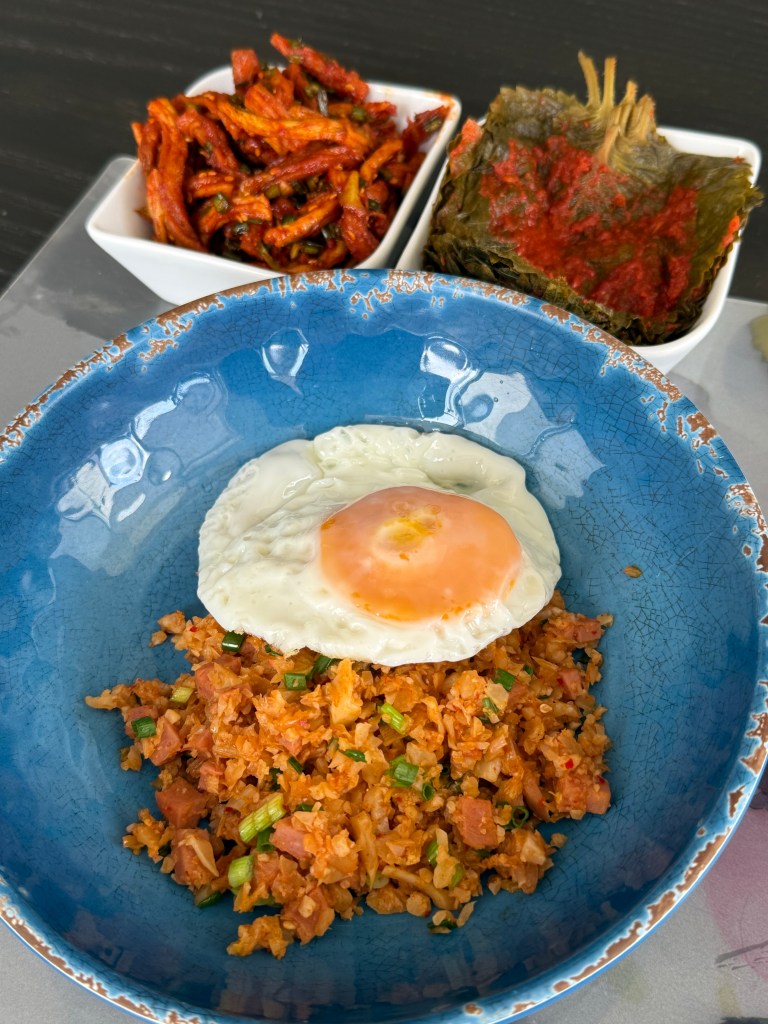
I’ve been on a Korean food cooking jag. I know the world over is enamored by K-pop and K-beauty but I’m so into K-food. It all originated from 20 years ago when I spent 2 years staying in the most Asian little town Fort Lee in New Jersey. It was a place where you hardly heard English in the streets and the waiters would grizzle at you in their native languages. But it was a time of discovery – smoky kalbi ribs served with rich tofu stew, dark and moorish jjajiangmyun so different from our Chinese version of 加酱面. It was the beginning of a love story.
When I came back to Singapore it was into a land with barely any decent Korean restaurants. And for years I would search and try to recapture those flavors but every Korean eatery would fall short…strangely it was the sundubu jigae (tofu stew) that I judged each place by. My gold standard was a little tofu restaurant round the corner from our townhouse in Fort Lee that was famous enough that Anthony Bourdain shot an episode on it. And because the ideal in my mind was impossible, I ended up trying to recreate it at home…thus starting the journey of cooking Korean food at home as a non-Korean.
And so I do have a decent repertoire and can churn out a decent budae jigae (soldier stew) and dakgalbi (spicy stir fried chicken). But I recently went for a Korean food class that was run by a lady out from her home and it was a next level experience. After going to her class I felt that my Korean home cooking to date is like a primary school level effort and she was showing us tertiary university level cooking. It was not so much the techniques; they were not difficult to master. It was the depth of flavors and how she was achieving it with some magical alchemy.
Anyway I thought I had a decent kitchen range of soy sauce, sesame oil, fish sauce, gochujang, doenjang and sesame seeds. But thanks to her I have a crate full of bottles of tuna sauce, anchovy sauce, anchovy fish broth, soup soy sauce, plum extract, hyangsin sauce and damari. Which means either I keep going back to class to learn more recipes to use up these ingredients or I keep cooking the same few recipes I learned from her.
Anyway simply because I had made her perilla leaf kimchi and dried radish and squid kimchi, I decided to cook some kimchi fried rice to at least be able to lay out the banchan I had made. Kimchi fried rice is a staple. You see it everywhere in little Korean stalls in food courts. But I felt I needed to write down a decent low carb version of this staple (mainly because if you don’t do it properly using cauliflower rice can make a soggy mess).
So here’s the recipe – fast and easy and really good. I used spam in the recipe because it’s kind of comforting and hearty, and also the kimchi should always be a bit more sour and maybe even almost going off in terms of shelf life (somehow more sour and umami!).
Low Carb Kimchi Fried Cauliflower Rice
Ingredients
- 1 large head of cauliflower, chopped into fine rice-sized grains
- 1 cup of kimchi chopped fine
- 2 tbsp gochujang
- 100g spam, diced
- 2 cloves of garlic, minced
- 3 tbsp peanut oil
- 1 tsp sesame oil
- 1 tbsp chopped spring onions (optional)
- 6 eggs
Ingredients
Directions
- Heat up 1-2 tbsp peanut oil in a wok/deep skillet
- Lightly saute the garlic till fragrant and add the spam and fry till the soam is slightly browned
- Add the cauliflower rice and lightly saute till the cauliflower rice is just cooked
- Add the kimchi and gochujang and fry another 2-3 more minutes. Add the sesame oil
- Take off the stove and top with the spring onions
- In a non-stick pan heat up 1 tbsp peanut oil over moderate heat. Fry each egg individually to desired doneness
- Plate the kimchi fried rice and top of with an egg on each portion. Serve hot

